
A successful retail promotion requires more than deciding which products to discount. Customers need to notice the promotion, understand the offer and find the relevant products inside the store.
Printed promotional materials help retailers communicate offers throughout the shopping environment, from shopfront windows and entrance areas to product shelves and checkout counters.
However, different display locations have different requirements. Planning the materials together can help retailers create a more organised promotional campaign and avoid last-minute production decisions.
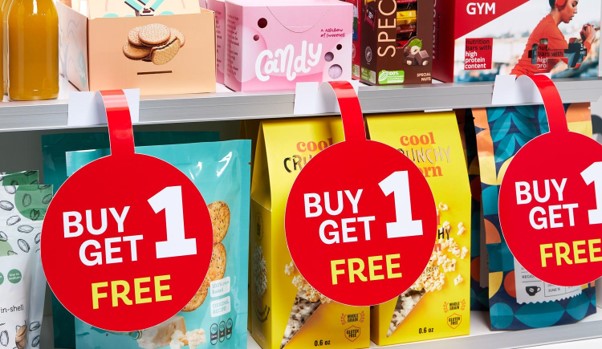
1. Start With the Retail Promotion and Its Objectives
Before choosing printed materials, retailers should establish what the promotion is intended to achieve.
For example, a campaign might focus on:
- Introducing a new product.
- Promoting seasonal offers.
- Increasing awareness of selected products.
- Advertising a store-wide sale.
- Supporting a new store opening.
- Highlighting a limited-time offer.
The objective determines which messages need to be communicated and where customers should encounter them.
A store-wide promotional campaign may require large window displays, while a product-specific promotion may benefit more from shelf-level communication.
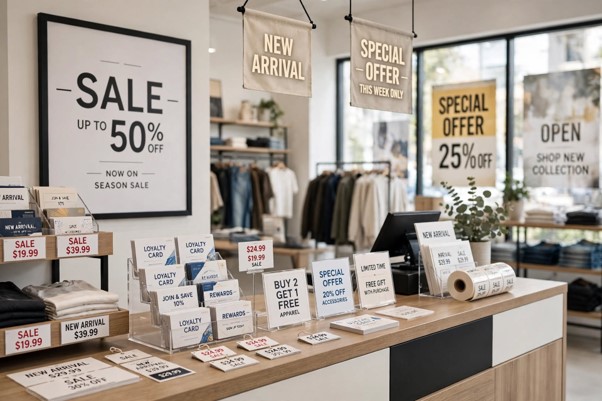
2. Consider the Different Areas of Your Store
Retail promotional materials should be selected according to where customers will see them.
Shopfront and Window Areas
Window displays help communicate promotional messages before customers enter the store.
Retailers may use promotional posters, window graphics and other display materials to highlight seasonal campaigns, special offers or new product ranges.
Entrance and High-Traffic Areas
Customers entering a store should be able to identify major promotions without having to search throughout the premises.
Large promotional displays, hanging signs and floor graphics can help draw attention to important areas.
Product Shelves and Display Areas
At the product level, communication needs to be more specific.
Shelf talkers, shelf strips and product display materials can highlight selected products, prices or promotional information.
Checkout and Counter Areas
Counter displays provide another opportunity to communicate relevant offers, introduce additional products or provide information about current promotions.
The selection should suit the available space and should not obstruct normal store operations.
Retailers planning a complete in-store campaign can explore Print Haus retail signage solutions for different display formats and applications.
3. Match Materials to Their Display Location
Not every printed material is suitable for every retail environment.
Before choosing a product, consider:
- Whether it will be displayed indoors or outdoors.
- How long the promotion will run.
- Whether customers will frequently touch the material.
- Whether the display will be exposed to sunlight or moisture.
- Whether the material needs to be repositioned or removed.
- How much viewing distance is available.
For example, a promotional poster in a shop window has different requirements from a small display positioned directly beside a product.
Material selection should be based on the intended application rather than choosing the same specification for every display.
4. Prepare Campaign Artwork Before Production
One of the common challenges in retail printing is coordinating multiple materials with different dimensions.
A promotional campaign may include window posters, shelf displays, hanging graphics and counter materials. Each needs artwork that suits its specific format.
Before sending files for production, retailers should check:
- Correct promotional wording.
- Product names and pricing.
- Campaign dates.
- Brand colours and logos.
- Image quality.
- Artwork dimensions and bleed requirements.
You can refer to the Print Haus artwork guidelines when preparing print-ready files.
5. Coordinate Production and Installation Timing
Promotional materials should arrive before the campaign is scheduled to begin.
Retailers should work backwards from the launch date and allow time for artwork approval, printing, delivery and installation.
For businesses with multiple stores, additional coordination may be needed to ensure every location receives the correct materials.
Preparing a product and quantity list for each location can help reduce confusion and make campaign distribution more manageable.
6. Plan for Future Retail Promotions
Many retail businesses run promotions throughout the year. Instead of treating each campaign as a completely separate project, it can be useful to maintain a record of previously used specifications.
This may include:
- Approved artwork templates.
- Standard display dimensions.
- Preferred materials and finishes.
- Store-specific quantities.
- Delivery requirements.
- Previous campaign production details.
Maintaining these records can make future ordering more straightforward while allowing retailers to update promotional content when needed.
Frequently Asked Questions
What printed materials are commonly used for retail promotions?
Common materials include promotional posters, window graphics, shelf talkers, shelf strips, wobblers, counter displays, ceiling hangers and floor graphics. The most suitable combination depends on the store layout and campaign objectives.
What is the difference between a shelf talker and a wobbler?
A shelf talker is positioned near a product on a shelf to communicate additional information or promotional details. A wobbler is generally attached using a flexible extension that allows the printed message to move slightly and attract attention.
Which printed materials are suitable for a shopfront window promotion?
Retailers commonly use promotional posters, self-adhesive window graphics and other display graphics. The appropriate choice depends on the window surface, display duration, visibility requirements and whether the material needs to be removed later.
How can retailers maintain consistent promotional displays across multiple stores?
Retailers can use approved artwork templates, standard dimensions, consistent brand guidelines and store-specific quantity lists. Coordinating these elements before production helps maintain a consistent presentation across locations.
How far in advance should retail promotional materials be ordered?
The timeframe depends on the products, quantities, artwork readiness and delivery arrangements. Retailers should allow sufficient time for proof approval, production and installation before the promotion begins.
Can different retail display materials be ordered as part of the same campaign?
Yes. Different display products can be planned together so that the campaign has consistent artwork and messaging across windows, shelves, floors and other store areas. Product availability and production requirements should be confirmed with the printing supplier.
Planning Your Next Retail Promotion
A well-coordinated retail promotion considers every customer-facing display location, from the shopfront to individual product shelves.
If your business is preparing a new campaign, explore Print Haus retail signage options to find suitable printed materials for your store and promotional requirements.