
Construction and property development projects involve more than building work. Throughout a project, businesses need to communicate site information, identify developments, guide visitors and present project details to the surrounding community.
Printed signage plays an important role in these activities. It can help identify a construction site, display development information and provide visual communication around project boundaries.
However, different stages of construction may require different signage formats and materials.
Builders, contractors and property developers should consider their signage requirements early so that suitable products can be prepared when needed.
1. Construction Site Identification Signs
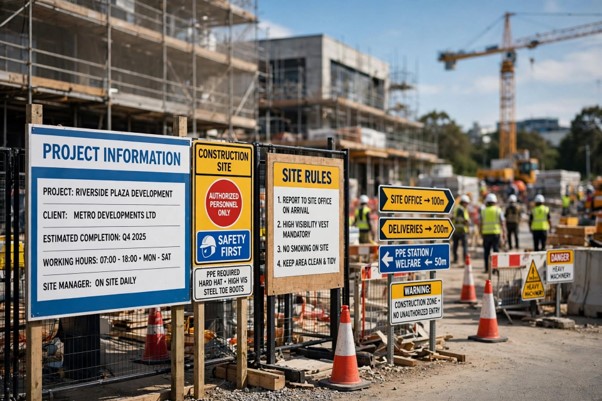
Site identification signage helps visitors, contractors and members of the public recognise a construction project.
Depending on the site, signs may display:
- Project or development name.
- Builder or developer identification.
- Company branding.
- Relevant contact details.
- General project information.
The sign should be easy to read from the intended viewing distance and suitable for its installation location.
For longer-term installations, material durability and mounting requirements should be considered before selecting a substrate.
2. Fence Banners and Project Advertising
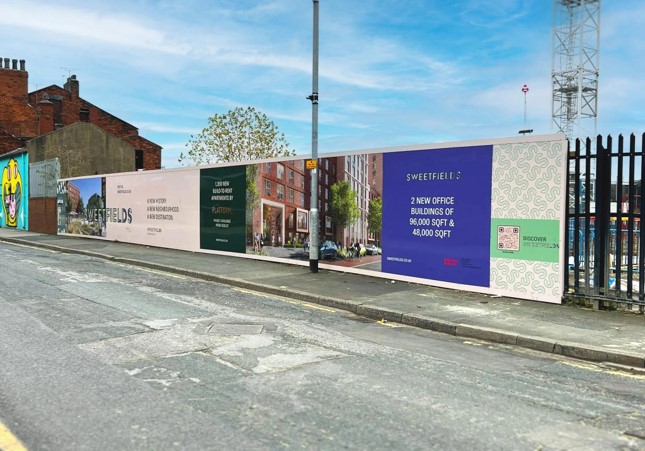
Construction fencing provides a useful area for communicating project information and displaying development branding.
Printed fence banners can help developers present a more organised appearance around project boundaries while communicating information to passing pedestrians and motorists.
They are commonly used to display:
- Development branding.
- Project imagery.
- Property marketing messages.
- Company information.
- Project contact details.
For exposed locations, mesh banner material may be worth considering because its perforated construction allows some airflow through the printed material.
Print Haus offers large-format banners and display products, including fence banner mesh options.
3. Building Wraps and Large-Format Project Graphics
Large construction and development projects may require graphics that cover substantial building surfaces or temporary structures.
Building wraps can be used to communicate project branding, development imagery and marketing information.
Before planning a building wrap, consider:
- The total surface area.
- The location and visibility of the installation.
- The required viewing distance.
- The material’s suitability for outdoor exposure.
- Installation and removal arrangements.
- Site access and safety requirements.
The artwork should be prepared at the correct dimensions and checked for visibility from the intended viewing positions.
Businesses with larger display requirements can explore Print Haus wide-format printing for information about available materials and large-format applications.
4. Directional and Information Signage
Construction projects can involve different access points, work areas and visitor arrangements.
Where appropriate, directional and information signs can help communicate site-specific instructions and guide authorised visitors.
Depending on the project, these may include:
- Entrance identification.
- Visitor direction signs.
- Parking information.
- Site office identification.
- Project information displays.
Safety and regulatory signs must be selected according to applicable workplace and construction requirements. General promotional signage should never be used as a substitute for mandatory safety signage.
5. Selecting the Right Materials for Outdoor Conditions
Outdoor construction signage may be exposed to sunlight, wind, rain, dust and frequent handling.
Material selection should reflect the expected conditions and how long the signage needs to remain in place.
For example:
Corflute: A lightweight corrugated plastic material commonly used for temporary signs and property displays.
PVC banner material: Suitable for a range of outdoor banner applications.
Mesh banner material: Useful for certain exposed fence installations where airflow is an important consideration.
Aluminium composite panels: A rigid option for more permanent signage applications.
The best material depends on the installation surface, exposure, display period and required finish.
6. Artwork and Installation Planning
Signage should be planned around the actual site dimensions rather than relying on standard sizes without checking the installation area.
Before production, confirm:
- Exact sign dimensions.
- Installation surface and mounting method.
- Required artwork and branding.
- Viewing distance.
- Outdoor exposure.
- Number of signs required.
- Installation access and timing.
For larger projects, it is useful to coordinate the artwork and production requirements across all signage elements so the overall presentation remains consistent.
7. Plan Signage Around Different Construction Stages
A construction project may need different communication materials as it progresses.
For example:
Project launch: Development identification and project branding.
Construction phase: Site identification, fence banners and relevant directional information.
Marketing and sales phase: Development imagery, property information and promotional graphics.
Project completion: Updated identification, wayfinding and other relevant information.
Planning these requirements in advance can help avoid unnecessary replacement costs and last-minute production requests.
Frequently Asked Questions
What signage is commonly required for a construction site?
Construction projects may require site identification signs, fence banners, development graphics, directional signs, project information displays and building wraps. The specific requirements depend on the project, site conditions and applicable regulations.
What is the best material for construction site signage?
The most suitable material depends on the intended use. Corflute is commonly used for lightweight temporary signs, mesh banners can be suitable for exposed fencing, and aluminium composite panels are an option for more permanent rigid signage.
Can construction fence banners be customised with project branding?
Yes. Fence banners can be produced with custom artwork, project imagery, logos and development information. The material and finishing requirements should be selected according to the fence installation and outdoor conditions.
Are mesh banners suitable for construction fencing?
Mesh banners can be useful on exposed construction fencing because their perforated structure allows some airflow. Their suitability depends on the installation, wind exposure and the support structure.
What information should appear on a development site sign?
A development sign may include the project name, developer or builder details, branding, relevant contact information and approved project imagery. Any mandatory site information or safety signage should be handled separately in accordance with applicable requirements.
How do I prepare artwork for large-format construction signage?
Start with accurate installation measurements and the intended viewing distance. Artwork should be prepared to the supplier’s required dimensions, resolution, bleed and finishing specifications. It is also important to confirm mounting and finishing requirements before production.
Can different construction signage products be ordered for one project?
Yes. Site boards, fence banners, rigid signs and large-format graphics can be planned as part of a coordinated project. Confirming the quantities, dimensions and delivery schedule together can help simplify production planning.
Discuss Your Construction Signage Requirements
Every construction project has different signage requirements, depending on its size, location, installation conditions and development stage.
Whether you need project identification signs, fence banners or larger promotional graphics, selecting the right materials and planning production early can help your project present a consistent and professional appearance.
Explore Print Haus wide-format printing services to discuss suitable signage and graphics for your next construction or property development project.