
Preparing for a trade show or business exhibition involves coordinating several different elements. Along with booking the exhibition space and organising staff, businesses need to prepare their stand presentation and supporting marketing materials.
Printed displays help visitors identify an exhibition stand, understand what a business offers and access information about its products or services.
However, forgetting even one important item can affect how effectively a business presents itself at an event.
Whether you are exhibiting at a local industry event or a major trade exhibition, preparing a printing checklist early can make the process easier.

1. Exhibition Backdrops and Display Stands
The main display is often the first thing visitors notice when approaching an exhibition booth.
An exhibition backdrop provides space for business branding, product imagery and key messages. Its dimensions and layout should be suitable for the available stand area.
Before ordering, consider:
- The overall dimensions of your exhibition space.
- Whether the stand is an inline, corner or island configuration.
- The distance from which visitors will view the display.
- The amount of information that needs to be communicated.
- Whether the display will be reused at future events.
Businesses preparing for exhibitions can explore Print Haus exhibition display printing for different display systems and graphic requirements.
2. Pull-Up Banners and Supporting Displays
A large backdrop is not always enough to communicate everything a business wants visitors to know.
Pull-up banners and additional display graphics can help highlight specific products, services or business information.
They are particularly useful for:
- Identifying different areas of an exhibition stand.
- Presenting individual product ranges.
- Highlighting key business capabilities.
- Supporting demonstrations and presentations.
- Providing additional branding around the booth.
When planning multiple displays, maintain consistent colours, typography and visual messaging.
3. Brochures and Printed Sales Materials
Visitors may want to take information away after speaking with an exhibitor.
Printed brochures and supporting sales materials provide a convenient way to present more detailed information than a display can accommodate.
Depending on the business, these materials may include:
- Company profiles.
- Product and service brochures.
- Product catalogues.
- Capability statements.
- Presentation folders.
- Event information sheets.
The content should be organised around the questions potential customers are likely to ask.
For businesses preparing printed sales literature, brochure printing services can help with selecting suitable formats and finishes.
4. Branded Counter and Table Displays
The exhibition counter is another important part of the stand.
It can be used for visitor registration, product information, brochures and sales conversations.
Depending on the display arrangement, businesses may consider printed table covers, counter graphics and supporting display panels.
These materials should fit the available space without making the stand difficult to navigate.
5. Floor Graphics and Additional Event Signage
Floor graphics can help reinforce branding, direct visitors or identify particular areas within an exhibition space.
They may be useful around the exhibition booth, product demonstration areas or designated visitor routes.
When considering floor graphics, check the venue’s requirements for approved materials, installation and removal.
Other supporting materials may include directional graphics, hanging displays and additional promotional signs.
6. Check Artwork and Production Requirements
A common exhibition preparation problem is leaving artwork approval until the last minute.
Different display products may have different artwork dimensions, file requirements and finishing specifications.
Before approving production, check:
- Correct artwork dimensions.
- Image resolution at final size.
- Brand colours and logo placement.
- Spelling and contact details.
- Bleed and safe areas.
- Correct artwork for each display component.
Review the Print Haus artwork guidelines before submitting print files.
7. When Should You Order Exhibition Printing?
Production timing should be based on the event date, number of products and complexity of the display.
As a practical planning approach, allow time for:
- Confirming the exhibition stand dimensions.
- Preparing and checking artwork.
- Receiving and approving proofs.
- Printing and finishing.
- Delivery to the required location.
- Checking all materials before travelling to the venue.
Larger display projects may require additional coordination, so it is sensible to discuss production schedules with your printing supplier early.
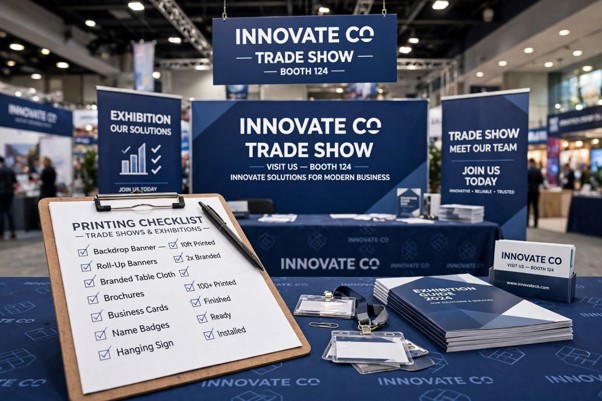
8. Prepare a Final Exhibition Printing Checklist
Before leaving for the event, confirm that the required materials have been produced and received.
Your checklist may include:
- Main exhibition backdrop.
- Pull-up banners.
- Branded counter or table display.
- Product brochures and catalogues.
- Business cards.
- Product information sheets.
- Supporting signage and floor graphics.
- Correct quantities of all printed materials.
Also check that the display components are compatible with their frames and hardware and that everything can be transported safely.
Frequently Asked Questions
What printed materials are needed for a trade show exhibition?
Common requirements include exhibition backdrops, pull-up banners, brochures, product catalogues, business cards, branded counters, table displays and supporting signage. The exact combination depends on the exhibition space and the business’s presentation requirements.
How early should I order exhibition display printing?
It is best to start planning several weeks before the event, particularly when ordering multiple display products. Print Haus advises allowing around 5–7 business days for standard exhibition printing and 10–14 business days for larger or more complex display systems, subject to confirmation.
Can exhibition displays be reused at different events?
Yes. Many display systems are designed for repeated use. Reusability depends on the display structure, storage conditions, transportation and whether the artwork remains relevant to future events.
What size should an exhibition backdrop be?
The size should be determined by the exhibition stand dimensions, venue restrictions and viewing distance. Always confirm the available booth measurements and display height restrictions before preparing artwork.
What should be included in an exhibition brochure?
An exhibition brochure may include a business introduction, product or service information, key features, relevant specifications, contact details and a clear explanation of how visitors can follow up after the event.
Can different exhibition display products be ordered together?
Yes. A business can coordinate backdrops, pull-up banners, brochures and supporting graphics as part of one exhibition project. Ordering them together also makes it easier to maintain consistent branding across the stand.
Get Your Exhibition Printing Organised
An exhibition stand should provide a consistent presentation, communicate important information and support conversations with potential customers.
Planning the printed materials early helps businesses coordinate their displays and avoid unnecessary last-minute changes.
Explore Print Haus exhibition display printing to discuss your requirements for an upcoming trade show, expo or corporate event.